Tuesday, February 19, 2013

On My Way


This past week has been busy getting ready for the end of our first two classes of the semester – Social Context for Community Development and Thai Cultural Arts. We have been writing papers, making presentations, and creating our final art projects. We have learned how to do traditional Thai batik from a famous Thai artist from Bangkok, learned how to cook deliciously savory Thai dishes from a restaurant owner down the street, learned how to roast coffee beans, and have learned how to make our own soap and ginger beer (non – alcoholic, don’t worry mom!) from Adele, the wife of the director of our program.


I have been writing a paper for my Thai Cultural Arts class based on the internship I will have this summer at Journeys of Hope: an organization based in Salem, MA that serves homeless and at risk youth between the ages of 18-23 in and around the North Shore. Journeys of Hope is an incredible grassroots organization that is serving people in our own back yards. We don’t have to go across the world to serve, to places we are ignorant of. We can and should be influencing the people in close proximity to us, being aware and caring for those in our own communities, because needs are all around us. Journeys of Hope is the only organization on the North Shore to address the needs of young adults who are homeless. They truly understand holistic development work in the communities they know best. This is the JOH website if you want to learn more or donate to their amazing organization: http://johma.org/

 On Saturday we will be on our way to our practicum sites. Christine and I will be headed just north of Thailand to the country of Laos to intern with a foundation called ARDA Skills. ARDA Skills was started by the Anglican Church of Singapore and is primarily an education center, teaching language skills in Lao and English, as well as vocational training for students to be trained in community jobs. The students are mainly from the Hmong hill tribe who cannot afford to go to high school and further their education. The Hmong are a minority group in Thailand as well as Laos. The skills center addresses business development and other skills that would make one employable to the community. One of the projects we will work with is teaching women how to run and operate a coffee shop to make a living.

 I will not be posting on my blog while I’m there because Laos is a very isolated communist country that monitors the kind of things like blogs, letters, emails, etc..
 In order to just play it safe, I will post about my time there as well as email friends and family when I’m back here in Thailand March 23rd. Don’t worry though, Laos will be a safe place for us to be for that month and we are in very good hands - more importantly, in God's hands. 

PS- This is an awesome blog about elephant advocacy in Thailand made by one of our friends here in Thailand. You need to read it, it is awesome.  http://theelephantquestion.wordpress.com/


also we found kittens in our rice shed! 


Peace! 

Friday, February 15, 2013

"Where There Are Karen, There Are Forests"

Last week, our group took a bus into the very northern city of Chiang Rai and a small truck about two hours north to a village in the mountains of the Karen hill tribe. One of our professors, Scott Coats started an organization called Mekong Minority Foundation which administers to the marginalized and exploited people groups of the hill tribes here in Thailand. He is an admirable man: someone of humility, meekness, and faith. What is even more admirable about his organization is that he successfully passed it off to local leadership of hill tribe people. This is the number one goal of development work and is rarely done. So many development organizations started by westerners believe they are doing good, but are really just keeping people in poverty. The typical western development worker facilitates dependency by keeping the white man in the position of the provider, and the local people in the position of the receiver. Scott truly understands the medium he works with. He understands the culture, the people, the context, and holistic development work. Scott took us to the Karen village so that we could learn about development projects that have gone on in the village by outside resources, as well as the conservational lifestyle of the Karen people.


The Karen people are, naturally, forest conservationists. One of the village leaders said to us, "where there are Karen in Thailand, there are forests. Where there no Karen, there are no forests." How true though. Being a minority group, the Karen people struggle with citizenship rights in Thailand, as well as simply being treated as lowly and dirty. But the Karen people are amazing. Historically animists, many Karen are now becoming Christians. Their lives are consumed with rice fields, church services, and living in community. How refreshing. When we arrived, one of the village leaders and elders, Ajan Suphon, told us when he heard we were coming, he thought he was going to learn from us, the westerners. Little did he know we were there to learn from him - sixth grade education and all. How sad is that though, that westerners are the teachers, and the rest of the world are the students. That just simply shouldn't be. We should not be setting the standard for quality of life. Our life may be consumed with materialism and success rates, but when can we just live in community and take care of God's perfect creation?


The Karen people are not in poverty, like someone passing by might think. They have what they need and they are happy with that. This is hard to find in many other minority groups in Thailand who have fallen into the materialistic trap of debt and dissatisfaction. The collection of Karen villages might be far away from other civilizations, but they are not suffering by any means. They have cows, chickens, loud roosters, pigs, and plenty of rice and vegetables to eat. They have a flowing water supply from a stream in the mountain, and beautiful teak houses.


So what defines a good life anymore? Is it having a great job? a boat? frequent vacations? lots of money? Or is it family, community, and belonging to a people who love you and love others like Christ  wanted. Ajan Suphon told us The Karen people's top priorities are harmony within the group and unity with each other. They have turned down thousands of dollars in grants because not every one in the village agreed to the project - because they make decisions collectively. True democracy i guess. Money doesn't govern their lives, like it does in many of our lives. The Karen just see happiness different than us. They don't consider themselves in poverty or suffering at all. They believe they have a fulfilled life because they tend to their spiritual life instead of their economic life.

Ajan Suphon and Ajan Liger teaching us about the village 

The Karen people are very intent on the preservation of the forest and natural life. Taking care of the environment around them just makes sense to them. It is down right clear in the Bible that God gave us creation - literal plants and animals. He didn't give us cars, money, and chemicals that pollute our bodies because those things are not essential to living a good life. If they were, God would have included them in his creation. He gave us, as humans, a job to be stewards of real creation. We are not only to just care about creation, but to care for it. Caring for something requires more than just thinking about it and saying it looks nice. It requires action. God gave us natural life - so why have we messed it up so much? Maybe we should simply use what God gave us instead of trying to always obtain more, using Karen life as an example. If we only look for the short term goods, our lives will certainly not make us happy.


"Worthy are you, our Lord and God, to receive glory and honor and power, for you created all things, and by your will they exist and were created" Revelation 4:11


Side Note: Remember my post about Namipan's amazing hand weaving? You can find her beautiful creations on Etsy.com here: 
http://www.etsy.com/shop/LiveLoveWeave?ref=search_shop_redirect

who wouldn't want a beautiful hand woven creation by a Lahu hill tribe woman in Thailand? 


Friday, February 8, 2013

Adventurous Weeks and Some Rants About Justice


This week was filled with so many adventures, and so many thoughts. As we are mainly learning about minority ethnic groups here in Thailand this first month, a lot of our adventures were based around these groups: mainly the Lahu hill tribe and the Karen hill tribe. These hill tribes are not Thai - they are immigrants from the north - and because of this, are looked down upon by the Thai community. 


As we left the comfort of our little home in Doisaket, the group ventured up the steep hills of Chiang Rai to the tribe of the Karen people – a very peaceful, community-oriented, and accommodating group of minority people who live in the forests of the hills as to preserve the natural earth amongst the ever growing industrious cities of Chiang Rai, Chiang Mai, and Bangkok. (Our time in the Karen village will have to be my next blog post because I could talk for hours about their lifestyle and theologies). Living and simply being in a village setting so rural and cut off from any other civilization or society really makes you think. It makes you think about how others live and about how you live. For me, being interested in communities and the very messy field of development work, it makes me think about how many westerners so wrongly view other cultures.

We as westerners are so dangerous in our modes of thinking. Pulling from what author Dorthy Sayers writes about, we tend to see things as problem and solution; but the world is just simply not that black and white. We see things that are foreign to us as problems to be fixed instead of beautiful yet different, and we end up exploiting others, and making the world a problem. We end up creating the problems that don’t exist, and then we don’t know how to fix the problem we ourselves have created. 


We westerners all have one goal in life: to be successful, to be happy and problem – free, always attempting to be better and better. We might have a certain vision of what life should look like for a certain group of people, but that vision is so many times not applicable for them. You can’t just take something that works in one context and plop it in another, expecting it to work. That is like going to a different country expecting everyone to speak your language. It is simply ignorant and arrogant. Meaning for life in all its fullness is different for different people. Many times we are too caught up in all our ‘things’ to really see that. For the Karen people, life is about harmony with one another, and harmony with God – intended nature, preserving as to not use and abuse the very thing that God has given us from the beginning.


That’s why we need to ask ourselves: why do we want what we want? Why do we really want that nice big house when only two people actually live in it? We create things because society tells us to, and we don’t ask why. We should ask ourselves, what really defines a good life? A white picket fence and a boat? (and try not to write this question off if you don't have either). We might need to start asking ourselves the intangible questions. Things might look good on the outside – like cheap stuff at Wal-Mart, or nice new Nike sneakers – but are so horribly wrong once you look under the table – like the child labor, exploitation, and physical poverty that both these companies ruthlessly drown innocent people in. Is that really what we want to be apart of? Do we really want to be apart of the process of physically hurting, exploiting and starving people to death? Good things are not always easy to find.

I have found we tend not to associate ourselves with the hard facts of life. We won't identify ourselves as wealthy people because to us, we are the middle class; even though to someone else, we are the upper class. But we would never identify ourselves as the poor either, not even spiritually speaking. There is always someone "poorer". We want to stay in the safe zone. We want to be on middle ground, so we don't ever 'shake the boat'. We wouldn't want to identify ourselves as exploiting the powerless and weak, even though we go to Wal-Mart every month and have three pairs of Nike shoes. We do this because of selfishness. We don't want to be rebuked or looked down upon because it doesn't feel good. But this creates an "us" vs. "them" dichotomy, not being one in Christ, but rather believing we are in the "safe zone" while those other people are sadly poor, and those other people are ruthlessly hurting the poor - but we would never be considered in either of those parties - right? 

However, we can find the good. Jesus said, “My power is made perfect in weakness”. We can take things that are seemingly bad and bring justice to that, because we are capable. Now we don’t necessarily have to go picket Wal-Mart or Nike or even go across the world to eradicate human trafficking, but maybe we can all act with discernment, love and grace on a daily basis – to those we see every day, and those who come into our lives unexpected.

“He has shown you what is good. What does the Lord require of you? To act justly and to love mercy and to walk humbly with your God” Micah 6:8 

Sunday, January 27, 2013

I Am an Artist

Taking a class called "Thai Cultural Arts" while here in Chiang Mai, i have found a new fondness for artists. I have always loved art. My sister is an artist - a really good one (http://seakettlediaries.blogspot.com/). The things she creates blow me away all the time. However, like my professor and philosopher, Michael Pucci, explains, she doesn't just poop in a can and call it art. She creates beauty out of the limits she has within her realm of creation. She takes the smallest canvas - a one - inch pendant (such a limited amount of space!) and paints a masterpiece on it. That is real art, and that is real beauty.

But i am an artist too - maybe not the same kind of artist as my sister. I cannot paint even one six hundredth as well as she can - but i create out of what is around me. We are all artists because we all create - whether it's a farm, a spreadsheet, or an essay. This is how, i believe, we know we are created in the image of God. Not necessarily in the physical sense, but because He created - and still creates; and from this, we create. Still, creation requires care. As we create, we care for those things we create because creation takes time, and particularity. For me, social justice and community development is one of the most important forms of caring for creation - being an artist in my own sense. Simply knowing the facts and having knowledge won't guarantee a beautiful life. It is not just simply thinking about and analyzing the world, but living in it, touching it, seeing it - being an artist. I feel like we are reduced as people because we don't know the rest of the world - not understanding God's creation in it's fullest form. We end up objectifying other cultures, making them something that fits into our small box-of-a worldview. I am not abroad 'to help' or 'to do good', as if i have the means and the superiority over others to help them, as if they are helpless. I am simply here to learn and to be. Understanding cannot be done when you have a schedule and a task. I am not a 'good person' for coming here. I am just an observer, a learner, a minority, and a respecter.

The other day we were able to witness an elder lady in the Lahu community we live in who weaves the old fashion way. Her name is Namipan. She is like the mother of this community. She cooks for everyone, she weaves to make a living, and she takes care of the children while their parents are in class. She is the glue to this small community of the Lahu hill tribe. As apart of our class, we watched her create a masterpiece out of the resources around her. She is a true artist. She started with four short sticks she pounded with a rock into the ground. She then took yarn and weaved it, in a very complex pattern between the sticks. This process only sets up the mechanism for the actual weaving. Because she weaves by hand, without a loom, she becomes the loom. She then takes the sticks/yarn mechanism and attaches it to a window. She rolls out the yarn and sits on the ground, literally strapped into the weaver. Finally, she begins the actual weaving process, using wooden sticks to make the patterns - in this case a poinsettia-looking flower. She told us weaving one piece of fabric can take all day, sometimes two.

 It is amazing to me that many people who don't see this process of hand weaving, don't understand the skills, the time and the patience it really takes. The creation, the actual incarnation, of the product is just as important as the final product itself. I would probably pay twice as much for Namipan's weavings than i normally would for something at the local market simply because i witnessed the time, effort and skill that went into her work. It is amazing, in our materialistic and consumeristic world, how much we don't think about where our products are coming from, who is making them and the quality of work put in. The price Namipan sells her products for definitely doesn't do her beautiful work justice. Maybe we should be more conscious of the things we consume every day, and maybe this will allow us to be artists in our own forms, for the things we care about the most.


 We will be putting Namipan's hand-woven products on Etsy.com soon! They are beautiful, look out!

Tuesday, January 22, 2013

Here

After a fourteen hour plane ride to Korea from Dulles, and a six hour plane ride from Korea to Chiang Mai, we finally made it here at the GoED house. The house is on a Lahu hill tribe bible school campus, and the campus itself is on a collection of rice fields. The rice fields are amazingly beautiful, especially in the mornings when the sun rises over them. The Lahu are a marginalized people group here in Northern Thailand. Since they migrated from Burma, live in the mountains, and speak Lahu instead of Thai, they do not have the same cultural expectations that the Thai people do, and therefore are seen as lowly and of a low status in society. This bible school is preparing them to be pastors for their various hill tribes. For some of them, this is their first academic experience at all.

View from our room on the fourth floor 

the house 
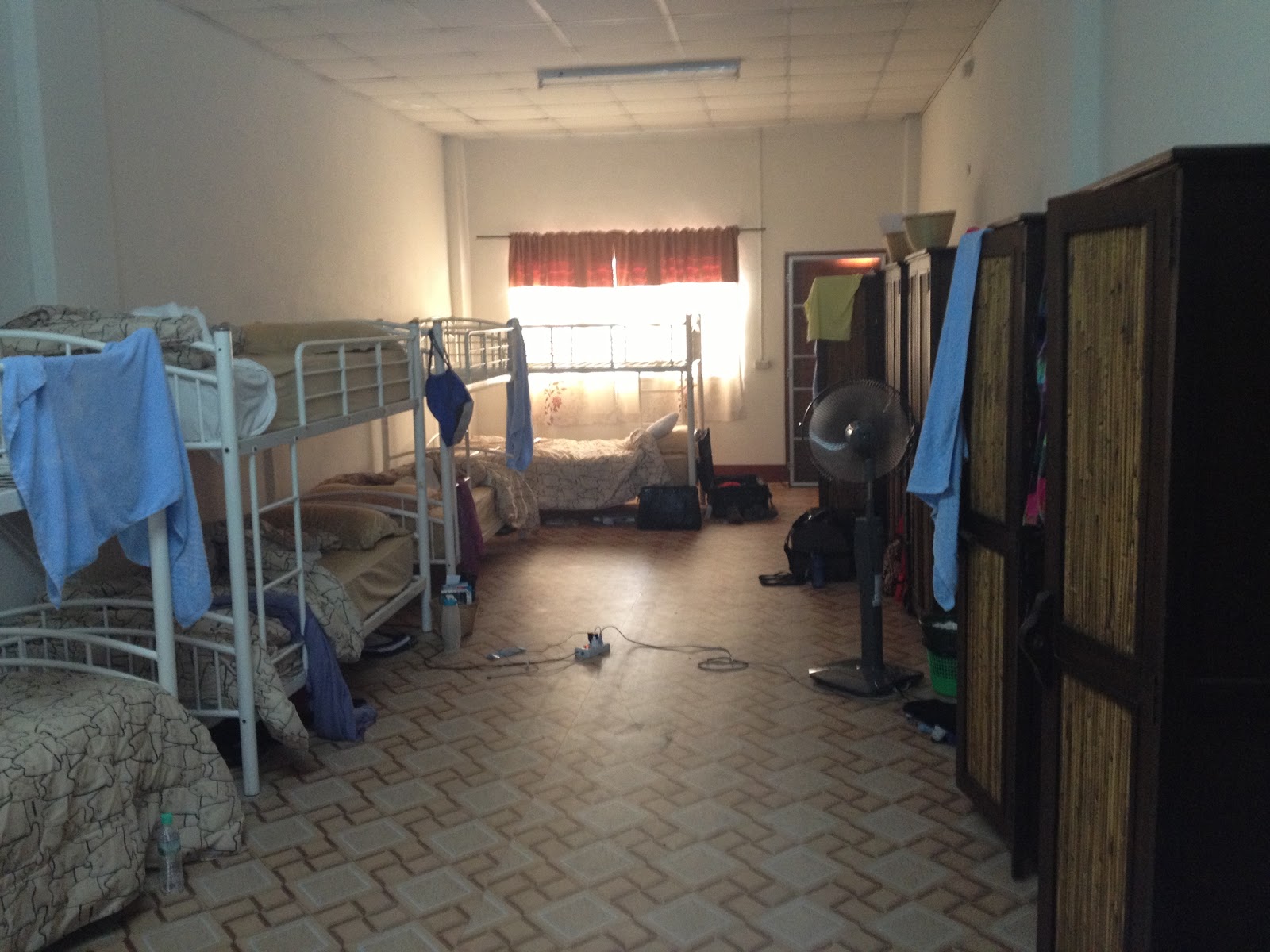
our room 


The past few days have been filled with numerous activities and adventures. We have been to the Lahu church, the local coffee shop, the Sunday Night Market, the Queen's botanical garden, an elephant farm, a hike to a beautiful waterfall, a Thai umbrella factory, a pottery place, a wood carving factory, and had tons of wonderful wonderful authentic Thai food. YUM.


This is considered 'the dish of the north', Khao Sawy. It is delicious beyond compare. It is a red coconut curry with egg noodles, cilantro, spices, sausage and pork with a crunchy noodle on top. I could have this every day if i could along with drinking out of a coconut. 


Thursday, January 10, 2013

Adventures in Chiang Mai, Thailand

I'm baaack!

Some of you might know, this is my second study-abroad blog. As a Sociology-Anthropology major at Messiah College, I am fortunate enough to be able to study abroad twice! Last year at this very time i was headed off to the beautiful country of Rwanda -- a country in central Africa you can barely see on the map. This country taught me a lot about forgiveness, poverty, development, hatred, love...the list could go on. It was an awesome experience i have such fond memories of. But we're not here to talk about Rwanda are we! you can read about that trip here: http//:www.rwanderingkimmie.blogspot.com

In eight days, i will be traveling back to Thailand... a place i also once called home. My mom, sister, Katie, and I lived in Bangkok, Thailand when i was in middle school as my mom worked at an international school called ICS - both Katie and I attended. Again, i have such fond memories of Thailand; and since we left that June in 2004, i vowed i would go back one day. That day is here! I just wish i could take them back with me because i know they would die to go back. However, this time i won't be in Bangkok. I will be in the northern region of Thailand called the Mekong Region (Mekong is a river that flows into China, Laos, Burma, Vietnam, and Cambodia as well). I will be in a city called Chang Mai. A little more rural and less crowded, loud and polluted than Bangkok (praise the Lord!)


My sister, Katie and I in Bangkok at a local temple c.2003


A little about my four months in Thailand:
I am going to Thailand with the same program i went to Rwanda with; a program called GoED (short for go education). This program specifically delves into certain issues in each country (Rwanda - poverty/reconciliation, Thailand - human trafficking). We learn specifically about international development, culture, religion, art, literature, etc. GoED focuses on applied learning and is a little bit more field-work based than other study abroad programs. The students going with me will all live in a house together, eat together, take trips together, meet the local community, etc.

The first month we will be taking two classes: Exclusion and Exploitation: The Marginalized People of the Mekong, and Social Context for Community Development. The second month we will be placed at an internship site. I won't know my practicum until that second month; so, more on that later! Lastly, our third month in Chang Mai, we will be taking two more classes: History, Religion, and Society in the Mekong, and Thai Cultural Arts -- i'm so excited for this one. I remember making baskets and flowers out of Thai fruits YUM.

So that's just a snippet of what i will be doing this semester abroad.
Thanks for taking the time to read this blog while i'm away -- or even just check in once in a while. I hope you will find it interesting/entertaining as i unpack what i will be learning and doing while i'm there. If you want to learn more about the GoED program, you can go to this website: http://go-ed.org/Mekong.html#


My next post will most likely be when i'm in Thailand so -- see you on the other side!

Kimmie